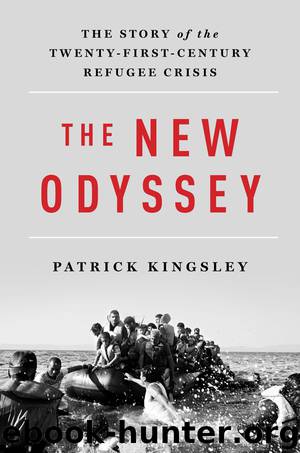
The New Odyssey by Patrick Kingsley
Author:Patrick Kingsley
Language: eng
Format: epub
Publisher: Liveright
Published: 2016-06-20T16:00:00+00:00
How and why did this happen? It’s a question that I’m asked increasingly as 2015 wears on, and the answer lies mainly in Syria. Refugees from other countries, not least Afghanistan and Iraq, do form a sizeable part of the flow, particularly once winter arrives. In their wake there is a far smaller percentage of so-called economic migrants from places including Bangladesh, Morocco and Senegal – and their numbers seem to rise once it becomes clear what a free-for-all this route is. Nevertheless, according to the UN, 66 per cent of the arrivals in Greece in the first ten months of 2015 are Syrians. Even if there are concerns about the accuracy of the UN’s data (which I’ll come to later), it’s clear that Syrians are the people who first led the surge. In one sense, that’s strange. The Syrian war has raged since 2011, and yet this drastic spike in arrivals to Europe is occurring only four years later. Why now, nearly half a decade on? And why here in Greece, rather than Italy?
There’s no exhaustive study on this, but in conversations with Syrians throughout 2015 a few themes repeatedly crop up. The first is that the war in Syria shows no signs of ending – and even if it does within a few years, the post-war country that emerges from the ruins will likely be a cantonised one, ripe for bitter recriminations. Faced with this prospect, Syrians have quite naturally realised they need to move to find long-term safety. The threat of Isis dominates the Western media, and certainly its rise is one reason why many Syrians have fled their homes. But Isis mostly control Syria’s unpopulated deserts. In the more populous areas run by more moderate rebel groups, the threat of Assad’s regular barrel bombs and Russian airstrikes are a much more pressing danger. In regions where the fighting and airstrikes haven’t yet become a daily fact of life, residents have the quite reasonable expectation that their homes won’t remain untouched for long. In Assad’s own strongholds, the fear of compulsory conscription is forcing out the many people who don’t want to fight for the dictator’s depraved army – while rebel rockets are also a regular danger. For the first two or three years of the war, most believed they could wait all this out, with many taking shelter in the houses of relatives and friends. But no longer. If your children haven’t been to school in several years, and if your home was destroyed in 2012, but it’s still not safe to return to rebuild it, it’s time for you to leave.
The year 2015 also marked the point when it became both easier and harder to leave in the first place. In 2014, when ‘only’ 125,000 Syrians claimed asylum in the EU,1 the biggest proportion of them came through Libya. By 2015, it was increasingly difficult to get there. By now, Libya’s eastern and western neighbours – Algeria and Egypt – had banned Syrians from entry,
Download
This site does not store any files on its server. We only index and link to content provided by other sites. Please contact the content providers to delete copyright contents if any and email us, we'll remove relevant links or contents immediately.
| Anthropology | Archaeology |
| Philosophy | Politics & Government |
| Social Sciences | Sociology |
| Women's Studies |
Cecilia; Or, Memoirs of an Heiress — Volume 1 by Fanny Burney(32558)
The Great Music City by Andrea Baker(32019)
Cecilia; Or, Memoirs of an Heiress — Volume 2 by Fanny Burney(31956)
Cecilia; Or, Memoirs of an Heiress — Volume 3 by Fanny Burney(31942)
We're Going to Need More Wine by Gabrielle Union(19046)
All the Missing Girls by Megan Miranda(16028)
Pimp by Iceberg Slim(14507)
For the Love of Europe by Rick Steves(14121)
Bombshells: Glamour Girls of a Lifetime by Sullivan Steve(14075)
Talking to Strangers by Malcolm Gladwell(13370)
Norse Mythology by Gaiman Neil(13365)
Fifty Shades Freed by E L James(13241)
Mindhunter: Inside the FBI's Elite Serial Crime Unit by John E. Douglas & Mark Olshaker(9343)
Crazy Rich Asians by Kevin Kwan(9292)
The Lost Art of Listening by Michael P. Nichols(7506)
Enlightenment Now: The Case for Reason, Science, Humanism, and Progress by Steven Pinker(7313)
The Four Agreements by Don Miguel Ruiz(6765)
Bad Blood by John Carreyrou(6621)
Weapons of Math Destruction by Cathy O'Neil(6280)
